Introduction
A motor with two separate windings will give the motor two speeds, because the windings are independent of each other the possible pole configurations are great. For each winding the number of poles may be any even number 12 to 2. For 50Hz supplies this gives speeds from 500rpm to 3000rpm for each winding. For 60Hz supplies this equates to 600 to 3600rpm.
Power Circuit
Control Circuit
Circuit Operation
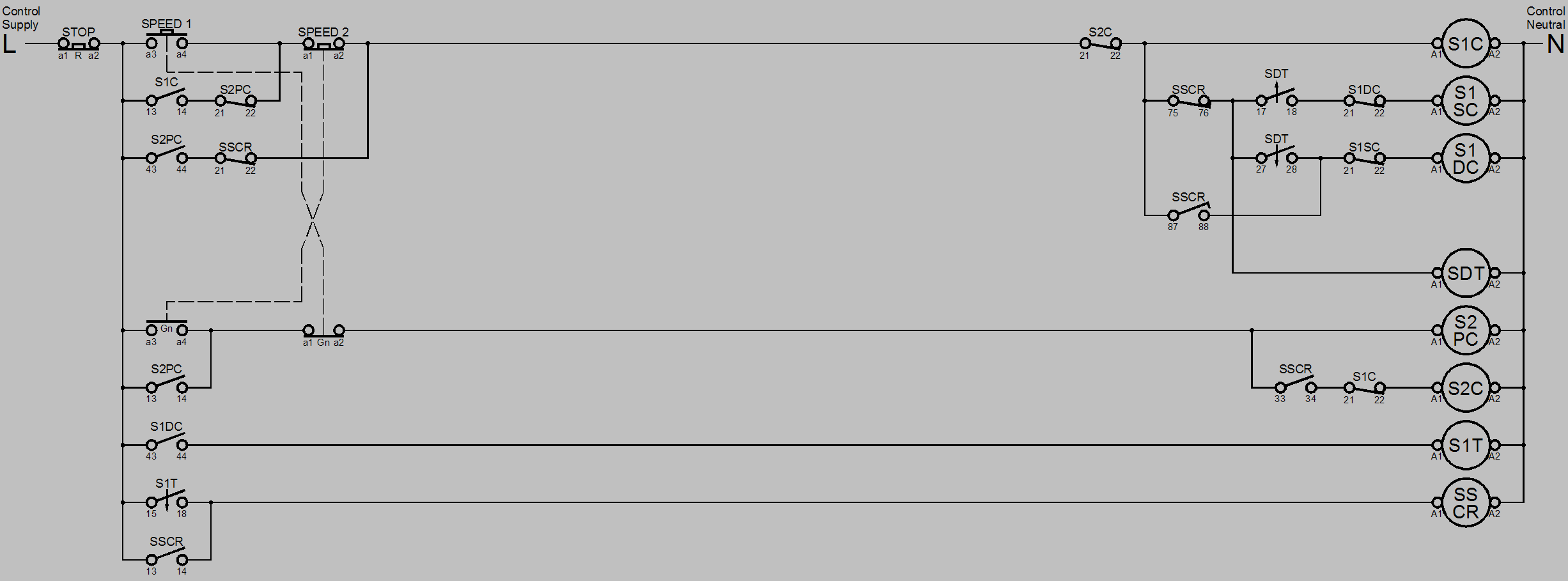
As star delta starting has been determined for speed 1 of this motor it follows that if the motor is at standstill and speed 2 is selected the motor will start at low speed in star accelerate to full speed in speed 1 in delta then switch over to speed 2. This is achieved by adding a pilot contactor to the speed 2 circuit and a start sequence complete relay.
When the motor is at standstill and the speed 1 start button is pressed it’s contacts a3-a4 close and a1-a2 open.
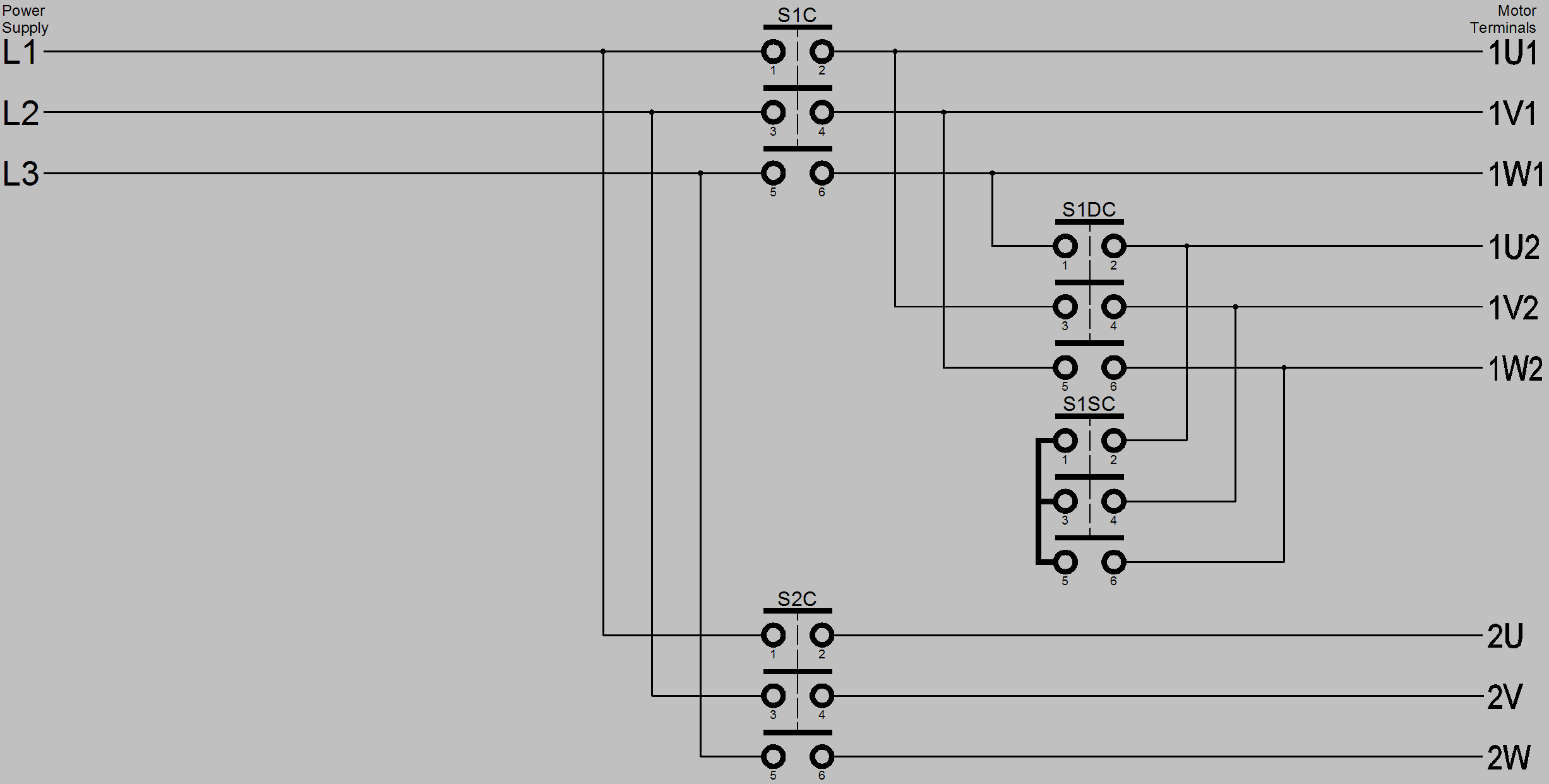
The speed 1 push button contacts on terminals a3-a4 energise the speed 1 contactor coil S1C is energised which causes the main contacts on terminals 1-2, 3-4 and 5-6 and its normally open auxiliary contact on terminals 13-14 to close. The auxiliary contact maintains power to the contactor coil when the start button is released. Power is connected from the power supply to the motor terminals 1U1, 1V1 and 1W1. At the same time the star delta timer SDT energises which causes its instantaneous close, delay to open contact on terminals 17-18 to close, this in turn energises the speed 1 star contactor S1SC which causes its main contacts on terminals 1-2, 3-4 and 5-6 to close and its normally closed auxiliary contact on terminals 21-22 to open. Motor terminals 1U2, 1V2 and 1W2 are connected together thus completing the motor circuit. The motor starts with a reduced voltage on each winding and accelerates to a speed that is load dependant. The voltage reduction is √3 of the line voltage. The star delta timer SDT is a special type of time delay relay that has two contacts. After a preset time the star delta timer SDT instantaneous close delay to open contact on terminals 17-18 opens which de-energises the speed 1 star contactor coil S1SC which causes its main contacts on terminals 1-2, 3-4 and 5-6 to open and its normally closed auxiliary contact on terminals 11-12 to close. The motor circuit becomes open circuit. The star delta timer SDT delay to close contact on terminals 27-28 closes 50-60milli-seconds after the preset time which opened the contact on terminals 17-18. The additional delay is to allow the speed 1 star contactor to open and its disconnecting arc to extinguish, it also allows the reset of any mechanical interlock between the speed 1 star and speed 1 delta contactors before the speed 1 delta contactor S1DC coil is energised. Star delta timer SDT delay to close contact on terminals 27-28 closing energises the delta contactor S1DC which causes its main contacts 1-2, 3-4 and 5-6 to close and its auxiliary contact on terminals 21-22 to open. The power supply is connected to motor terminals 1U2, 1V2 and 1W2. Thus each winding has the full voltage applied to it, the motor accelerates to full speed in speed 1.
When the motor is at standstill and the speed 2 start button is pressed it’s contacts a3-a4 close and a1-a2 open.
The speed 2 push button contacts on terminals a3-a4 energise the speed 2 pilot contactor S2PC it’s contacts 13-14, 43-44 close and 21-22 open, the contact on terminals 13-14 maintains power to the speed 2 pilot contactor when the button is released, the closing of the contact on terminals 43-44 initiates the speed 1 starting sequence which operates as detailed above, whilst the normally closed contact on terminals 21-22 opens to prevent the speed 1 contactor S1C maintaining circuit from keeping the speed 1 contactor energised.
At the completion of the speed 1 starting sequence the starting sequence complete relay SSCR energises the contacts on terminals 13-14 closes to keep the relay energised another contact on terminals 21-22 opens which de-energises the speed 1 contactor and another contact on terminals 33-34 closes to complete the circuit to the speed 2 contactor coil S2C which energises causing it’s main contacts on terminals 1-2, 3-4 and 5-6 and auxiliary contacts on terminals 13-14 to close. Power is connected from the power supply to the motor terminals 2U, 2V and 2W. The motor now accelerates to full speed in speed 2.
To change speed whilst the motor is running it is only necessary to press the appropriate button which will cause the energised speed contactor to de-energise and the de-energised speed contactor to close. Where that speed change is from speed 2 to speed 1 the motor is connected in delta without going through the star connection phase due to contacts of the start sequence complete relay SSCR on terminals 75-76 and 87-88. These contacts are a special type they are both late break early make with the contact on 75-76 being normally closed and 87-88 normally open. The purpose of these special contacts is to ensure that the star delta timer does not de-energise when the start sequence complete relay energises.
To stop the motor the stop button is pressed its contacts a1-a2 open which de-energises the energised contactors, relays and timers thus stopping the motor by removing its power supply and resetting the control circuits.
The auxiliary normally closed contacts on terminals 21-22 of the speed 1 S1C and speed 2 S2C contactors are placed into each others coil circuit so that electrically the two contactors cannot be simultaneously energised which would cause an overload in both windings, this can be seen by examination of the above circuit. It is normal to mechanically interlock the speed 1 and speed 2 contactors in addition to the electrical interlock.
The auxiliary normally closed contacts on terminals 21-22 of the star SC and delta DC contactors are placed into each others coil circuit so that electrically the two contactors cannot be simultaneously energised which would cause a short circuit, this can be seen by examination of the above circuit. However it is normal to mechanically interlock the star and delta contactors in addition to the electrical interlock.